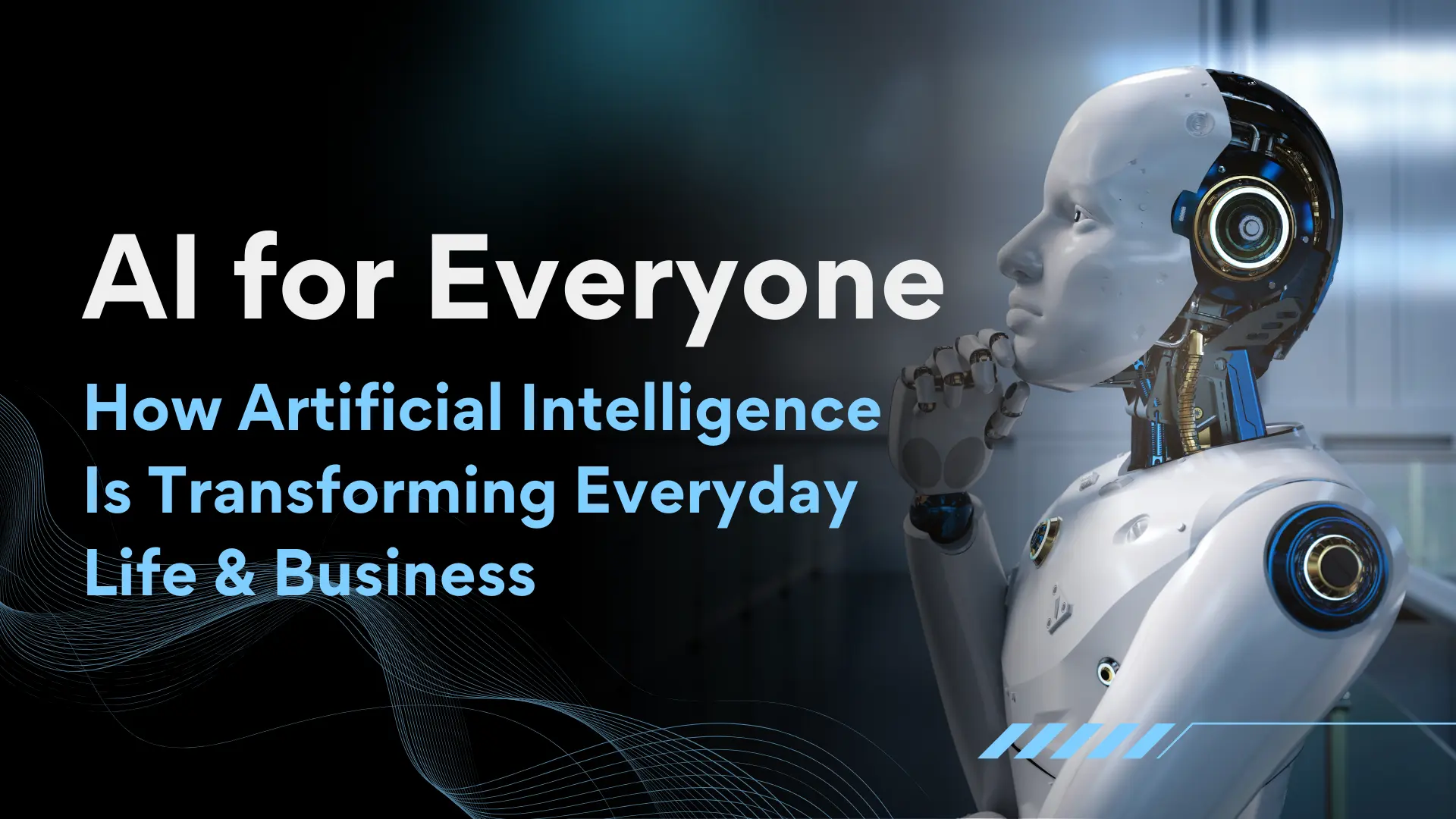
AI for Everyone: How Artificial Intelligence Is Transforming Everyday Life & Business
AI Is No Longer the Future — It’s the Present
Artificial Intelligence (AI) is no longer limited to science fiction movies or advanced research labs. Today, AI quietly powers many of the tools and services we use every day — from smartphones and online shopping to healthcare, banking, and entertainment.
Whether you realize it or not, AI is already part of your life. It recommends what to watch on Netflix, helps Google Maps find the fastest route, filters spam from your emails, and even assists doctors in diagnosing diseases.
This blog is written for general consumers, not just tech experts or big businesses. We’ll break down AI in simple language, explore real-life examples, discuss benefits and challenges, and look at what the future holds — all without technical jargon.
What Is Artificial Intelligence (AI)? (In Simple Terms)
Artificial Intelligence refers to computer systems designed to perform tasks that normally require human intelligence. These tasks include:
- Learning from data
- Recognizing patterns
- Making decisions
- Understanding language
- Solving problems
Types of AI You Should Know
|
Type of AI |
What It Means |
Everyday Example |
|---|---|---|
|
Narrow AI |
Designed for a specific task |
Voice assistants like Siri or Alexa |
|
Machine Learning |
AI that learns from data |
Netflix recommendations |
|
Deep Learning |
Advanced learning using neural networks |
Face recognition on smartphones |
|
Generative AI |
Creates new content |
AI writing, images, and videos |
Most AI we use today is Narrow AI, built to do one thing very well.
AI in Daily Life: Real-World Examples You Already Use
You may not notice it, but AI touches almost every part of your routine.
1. Smartphones & Apps
- Face unlock and fingerprint recognition
- Voice typing and smart replies
- Camera enhancements and photo editing
2. Online Shopping & E‑commerce
- Product recommendations
- Price comparisons
- Chatbots for customer support
3. Social Media & Entertainment
- Content recommendations on YouTube, Instagram, TikTok
- Automated content moderation
- Personalized ads
4. Banking & Finance
- Fraud detection
- Credit scoring
- Smart budgeting apps
5. Healthcare
- Early disease detection
- Medical imaging analysis
- Virtual health assistants
AI works silently in the background, making services faster, smarter, and more personalized.
How AI Is Helping Businesses (Without Replacing Humans)
A common fear is that AI will replace human jobs. In reality, AI is more about supporting people than replacing them.
Key Benefits for Businesses
- Automation of repetitive tasks
- Better customer service through chatbots
- Smarter decision-making using data
- Cost savings and efficiency
Simple Business Use Cases
|
Business Area |
How AI Helps |
|---|---|
|
Marketing |
Personalized ads & content |
|
Customer Support |
24/7 AI chatbots |
|
Sales |
Demand forecasting |
|
HR |
Resume screening |
|
Operations |
Process automation |
AI allows employees to focus on creative, strategic, and human-centric tasks.
Benefits of AI for Consumers
AI isn’t just for companies — it directly improves everyday consumer experiences.
Key Advantages
- Saves time by automating tasks
- Improves accuracy in recommendations and predictions
- Enhances personalization
- Increases accessibility for people with disabilities
- Reduces human error
Example: AI-Powered Accessibility
- Speech-to-text for hearing-impaired users
- Text-to-speech for visually impaired users
- Smart assistants for elderly care
AI, when used responsibly, can make life more inclusive.
Challenges & Ethical Concerns of AI
While AI offers many benefits, it also raises important concerns.
Key Challenges
- Data Privacy – AI systems rely on personal data
- Bias in Algorithms – Biased data can lead to unfair outcomes
- Job Displacement – Some roles may change or disappear
- Misinformation – AI-generated fake content
- Over-reliance on Technology
Responsible AI Is the Solution
Governments, businesses, and technology providers must work together to ensure:
- Transparent AI systems
- Ethical data usage
- Human oversight
- Strong regulations
The Future of AI: What to Expect in the Next 5–10 Years
AI adoption is accelerating rapidly. Here’s what the future may look like:
Upcoming AI Trends
- Smarter virtual assistants
- AI-powered education & personalized learning
- Autonomous vehicles
- Advanced healthcare diagnostics
- AI-generated content becoming mainstream
Simple Forecast Table
|
Year |
AI Impact |
|---|---|
|
2025 |
AI everywhere in apps & services |
|
2030 |
AI as personal digital companions |
|
Beyond |
Human-AI collaboration becomes normal |
The future isn’t AI vs Humans — it’s AI with Humans.
How Consumers Can Prepare for an AI-Driven World
You don’t need to be a programmer to benefit from AI.
Practical Tips
- Learn basic AI concepts
- Use AI tools responsibly
- Be aware of data privacy
- Adapt to new digital skills
- Stay informed about AI trends
Digital awareness is the new literacy.
How Nori Technology Supports AI-Driven Digital Growth
At Nori Technology, we focus on helping businesses and consumers adapt to the evolving digital landscape through:
- AI-powered digital solutions
- Automation strategies
- Smart website & app development
- Data-driven marketing approaches
🔗 Internal Link: Learn more about our digital services: /services
Our approach prioritizes human-friendly technology that delivers real value.
Conclusion: AI Is for Everyone
Artificial Intelligence is not something to fear — it’s something to understand and embrace. From improving daily convenience to transforming industries, AI is shaping a smarter, more efficient future.
For consumers and businesses alike, the key is awareness, responsibility, and adaptability.
At Nori Technology, we believe AI should be accessible, ethical, and human-centered — empowering people, not replacing them.
Frequently Asked Questions (FAQ)
1. Is AI safe to use?
Yes, when developed and used responsibly with proper regulations and data protection.
2. Will AI take away jobs?
AI may change job roles, but it also creates new opportunities and industries.
3. Do I need technical skills to use AI?
No. Most AI tools are designed for everyday users.
4. How does AI learn?
AI learns by analyzing large amounts of data and identifying patterns.
5. Is AI expensive?
Many AI-powered tools are affordable or even free for consumers.

.webp)